Monday, March 31, 2008

Wolfschanze


Once upon a time during my ill spent youth in the late 1970's I was on maneuvers in West Germany north east of Lüneburg Heath and close to the Inner German Border and was sent to find our Brigade Headquarters (a mobile collection of Landrovers and Armoured Personel Carriers with a great mass of aerials).

Wending deeper and deeper into the German forest, aiming for a map reference, we eventually and suddenly came upon an old abandoned wooden guard hut with a broken barrier. Driving through we realised there were a few more decrepit huts and then large concrete structures loomed out of the forest gloom. Overgrown with moss, they had earth on their roofs - which were six, eight or even ten feet thick - deep with forest mulch and from which there were now growing quite sturdy trees.


Some were damaged and cracked, with heavy riveted steel doors hanging off their brackets and recessed machine gun slits with ferns growing out of them; while others still appeared to be in surprisingly good shape.


The British 7th Armoured Brigade Headquarters had set itself up amongst the remains of one of Hitler's command bunkers.


After delivering our dispatch and before leaving we took a look around - there were still odd remnants of their previous occupiers, broken chairs, some moldy wartime newspapers, yellowed notices on noticeboards, rusting Wermacht cooking equipment. But it was that first experience of encountering the bunkers in the dark green of the forest that has stayed in my memory.


Now, it wasn't the Wolfshanze - Hitler's Wolf's Lair - which was in Eastern Prussia - now Poland, although it was a substantial complex. But when I came across these photographs of the Wolfshanze by Swiss photographer Tonatiuh Ambrosetti, it certainly brought back that fascinating - if somewhat formidable experience. (via wood_s_lot)

(BTW, Ambrosetti also has some other good work on his site, such as Rocs2, Memento and War Games)


Stephen Gill correction

Just a quick note - the url for Stephen Gill's book and print sales hadn't taken in the post below. It's corrected now so you can actually find it....

Sunday, March 30, 2008

Stephen Gill - prints


Now here's an opportunity I wish I could take advantage of right now... I'd guess that if you have the spare cash around (even if you need to eat Kraft Dinner for a week :-( ), this is an opportunity not to miss.

I've talked about Stephen Gill a couple of times and really quite like a lot of his work. And considering how quickly his books go out of print, I'm not sure how long most of these will stay on the shelf:


New Special Edition Stephen Gill Prints available

These single collectors prints are limited to 50 of each and are from selected project series including - Billboards, Hackney Wick, Hackney Flowers, Archaeology in Reverse and Warming down.

The prints are signed and numbered and printed to the highest quality on 12” x 10” Fuji Crystal c type paper.
The images will be shipped in April / May 2008.
(Available here - you can also get his books here at the same site)
Finally, do note that those prices are in Pounds (£) Sterling, so they aren't quite as cheap as they look across this side of the Pond at first glance, but I'd still say pretty good value.


Thursday, March 27, 2008

The world's oldest photograph - 1790?


A photograph (well, actually a Photogenic Drawing - basically an early photogram) just know as "Leaf" is coming up for auction at Sotheby's and may possibly be the oldest photographic representation in exisitence.

It had previously been attributed to William Henry Fox Talbot, one of the founding fathers of photography. Fox Talbot made a number of other leaf prints and this one was though to have been made by him in about 1839.

But new research suggest it might well have been made as early as 1790 by Thomas Wedgwood, James Watt or Humphry Davy, who were all early experimenters in photography.
"...Sotheby's says research by a leading photo expert suggests otherwise - that several early photo experimenters could be the authors, including Thomas Wedgwood, James Watt and Humphry Davy, who worked in the medium decades earlier. If that theory is true, it means the photo could have been made as early as 1790..

All six photogenic drawings were contained in an album belonging to Henry Bright of England whose family had a close social connection to the Wedgwoods, Watt and Davy, adding further support to the theory that "Leaf" could be by one of them, Sotheby's said...

The work of Wedgwood, of Wedgwood china fame, Watt and Davy was documented in their day and cited in standard histories of photography, but no examples have ever been identified, Sotheby's said... (more at the CBC)


You can check out the auction at Sotheby's - item #43 (you need to log in to see the full details) - and get your wallet out on April 7th. Maybe you could own a bit of photographic history.... (oh and take a look at some of the other work in the auction while you are there).

There is a fairly extensive essay in the online catalogue:

"In 1984, Sotheby's in London sold a small group of anonymous photogenic drawings that were originally part of an album assembled by one Henry Bright. The photogenic drawing offered here was among that group, and after the Sotheby's sale, it was re-attributed to William Henry Fox Talbot. Dr. Larry Schaaf, the Talbot authority, has questioned that attribution, and in the essay below, explores other possibilities of authorship, including Thomas Wedgwood or members of his circle.

It may seem surprising that photogenic drawings are such very rare survivors. William Henry Fox Talbot published the full details of how to make them by February 1839. While fraught with uncertainties, the process was relatively simple, used readily available materials and was widely published in the popular journals in the months following Talbot's disclosure. Public demonstrations were given and kits of materials advertised in the newspapers. One must assume that many hundreds of amateurs, scientists, artists, and others were fascinated by getting nature to draw her own image. Following Talbot's published instructions, an experimenter had only to take a sheet of writing paper, soak it in a weak solution of common table salt, and then brush it with silver nitrate. Light sensitive silver chloride would be formed within the fibers of paper. This sensitive paper was then placed in the sun under a leaf or other object and within minutes the energy of the light would reduce the silver chloride to tiny particles of silver, appearing red or purple. The image was a negative, of course, for where the object blocked the light, nothing happened, but where the light reached around or through the object, the paper darkened. At this stage, it could be examined by candlelight, or fixed to make it more resistant to the sun's rays.

Yet virtually none of what we know must have been produced seems to have survived.(1) One explanation for this loss might lie in human nature, for the succeeding generations that have proven to be dismissive of great-aunt Susan's amateur watercolors would probably have thought even less of her sun drawings. Perhaps more importantly, most of these would have remained sensitive to light and those most treasured and admired, paradoxically, probably got the most viewing and were consequently destroyed. The largest known body of surviving photogenic drawings was done by Henry Talbot himself. Yet this leaf, and its companions, do not fit into the corpus of known work by Talbot and his circle. That leads us to contemplate just how it came to be created - and why it has survived."...(Sotheby's)

It still sounds a bit of a long shot, but not impossible by any means. It would certainly be nice for the Brits to have been the ones to have fixed this particular shadow first :-)

Wednesday, March 26, 2008

Bert Teunissen - Domestic Landscapes?


Bert Teunissen and his mega-project Domestic Landscapes (on his website and published by Aperture) seems to be all the rage right now (and good on 'im for it), but his work really doesn't do it for me.

He examines domestic environment - which are apparently dissapearing - along with those who inhabit them. But I don't find the photographs terribly interesting or convincing - especially when you line up the hundreds he has taken. Individually, or two or three at a time, possibly. The style is particularly off-putting - rather than reflecting the work of the Dutch Old Masters (as someone like Elger Esser successfully does), they seem much more closely related to the somewhat forced style of early colour news magazines. The use of colour in particular seems fairly incidental - rather like Robert Polidori's interiors. In fact these resemble many of Polidori's interiors in style, but with people dropped in and the use of colour is essentially cosmetic.


"Over the past decade, Dutch photographer Bert Teunissen has documented hundreds of old European homes. These are rudimentary yet cultured settings aglow with a warm, timeless atmosphere; spaces in which a primary interior feature is that of natural light. Old World details crowd the frame of each image: ornate wallpaper, ancestral portraits, home-cured hams hung from exposed beams, and decorative dishware proudly displayed on mantels. The homes pictured here were built before the World Wars, before electricity was a standard feature, a time when sunlight played a pivotal role in the conception of architecture. Teunissen renders these last vestiges of old Europe with a palette and sensitivity to light that recall Dutch masters like Vermeer and Rembrandt." (Aperture)

Overall he seems to have produced what is effectively a typology of lonely old men and women of Europe (thanks SG) - a sort of conceptual nostalgia. And that's where I think the problem lies for me - this is a very conceptual work - and yet it is a topic which would work far better without being bound by a theory - swap concept for context and focus on the subjects and it might have worked better - a lot better.


The other problem with the concept, that apparently informs and guides this work, is that it embraces a whole lot more things and ideas than the work shows in its limited range - so the pictures generally tend to fall short when compared to the words. By comparison, reading John Berger's "Into Their Labours" trilogy (Pig Earth,
Once In Europa and Lilac and Flag) conveys similar ideas with far more rigour and vision and much greater reflection on the "european peasant" and the migration from countryside to city (among several other themes).


"Some photographers think the idea is enough. I told a good story in my Getty talk, a beautiful story, to the point: Ducasse says to his friend Mallarmé — I think this is a true story — he says, “You know, I’ve got a lot of good ideas for poems, but the poems are never very good.” Mallarmé says, “Of course, you don’t make poems out of ideas, you make poems out of words.” Really good, huh? Really true. So, photographers who aren’t so good think that you make photographs out of ideas. And they generally get only about halfway to the photograph and think that they’re done." John Szarkowski
In looking at these pictures, I compare them to the work of something like The Day-to-Day Life of ALbert Hastings, or the (horribly titled) For every minute you are angry you lose sixty seconds of happiness - both of which seem to embody an honest affection for the subjects of their work rather than the pinned butterfly collection of Domestic Landscapes. There's a bigger gap than we might generally think between detachment or a lack of sentimentality - and unemotional distance. And that, ultimately, is what comes across to me in this work - that cool distance.


Tuesday, March 25, 2008

Transformer Houses


A few years ago I came across this work by Canadian photographer and artist Robin Collyer and then I came across a few the other day on the web.

These aren't houses, but rather they are disguised electrical substations, complete with windows, curtains and a bit of lawn and landscaping
.


This is one of those things you can really do only once and that you luck into and just come across. I just like the idea of tracking these places down, as well as exploring the ideas behind the mind of a Utility deciding to do this, and how it replicated the feel of homes in different neighbourhoods.


"During the 1950s and 1960s, the Hydro-Electric public utilities in the metropolitan region of Toronto built structures known as 'Bungalow-Style Substations.' These stations, which have transforming and switching functions, were constructed in a manner that mimics the style and character of the different neighborhoods... there are about 100 of these structures located on residential streets in the central and the suburban parts of the greater Toronto area."


All in all rather neat.


Monday, March 24, 2008

Robert Frank Extravaganza


At the end a nice Easter Break (well, it had a 4 year old's birthday party in the middle of it...), I sat down to read the long Vanity Fair article on Robert Frank: Robert Frank's Unsentimental Journey - amazingly (VF, The New Yorker etc never seem to have the article you want to read online), they have the whole article on their website.

Charlie LeDuff in Vanity Fair on a Trip with Frank (at 83) to China:

...“It amazes me,” he said. “It’s a book of such simplicity, really. It doesn’t really say anything. It’s apolitical. There’s nothing happening in these photos. People say they’re full of hate. I never saw that. I never felt that. I just went out to the street corners and looked for interesting people. O.K., I looked for the extremes, but that’s because the mediocre, the middle, it’s bland and that bores me.


“They called the book drab and sad. But at that time photography wasn’t that advanced. It’s not drab and sad. This is what it was. I had no idea. There was no agenda. I was absolutely amazed when I went to the South. The stupidity. It was sadistic then.

“But looking at these pictures now, I don’t see what all the fuss was.”


The truth of the matter is the book was a drive-by job. The pictures feel intimate, but in a way they are, like their creator, cold and Germanic. He did not stop for lunch at the sharecropper’s house. He did not know the name of the undertaker for whom the funeral was held. “No time, no time. I had to move,” he remembered. And so he piled into his Ford Business Coupe and kept heading west.

“I only ever spoke to one person,” he said. “The woman who got married in Reno. She called up her father to say she was married and he hung up the phone on her.”...

...In the early morning, before sunrise, the ancient city was still cloaked in gray and shadow, and I stumbled through the stone streets in a bout of jet lag and self-loathing. Whom should I meet wandering the streets in a pair of blue work trousers looking fatigued and disoriented? It was Robert Frank, with his Russian-manufactured Lomo point-and-shoot camera, tears in his eyes. I watched him take snaps for a while and roll a little video before his legs started to give out. We settled on a noodle shop and ordered tea and potatoes and sour buns.


He’d been having dreams on this fantastic trip to China, he told me. Undoubtedly the last trip before the Ultimate Trip. He talked about ego, the marrow and the mistake of the artist. The sacrifices one makes in pursuit of genius. “The children. That’s my regret. There is so much guilt there,” he said, rubbing some imaginary stain on the plastic tablecloth...

...“So do you like China?,” I asked.

“Not when I see this,” he said, referring to the old people dancing to a mindless tune. “I see this and I think, Obey. No, I like America. I’ve become an American absolutely.”...

...Robert Frank is an enigma: hard and empathetic and melancholic all at once. He abhors schmaltziness and syrup. I asked him if he would like to see a photograph of my baby. He answered, “Why should I want to see that?”


It is the same with him about photography. Digital photography destroys memory, he believes, with its ability to erase. Art school is another problem, teaching students to be blind. Editors are worse—they poke the artist’s eyes out. Photography: one minute it’s not art at all. Then perhaps it is. And then again it is not. That’s Robert Frank.

“There are too many images,” he said. “Too many cameras now. We’re all being watched. It gets sillier and sillier. As if all action is meaningful. Nothing is really all that special. It’s just life. If all moments are recorded, then nothing is beautiful and maybe photography isn’t an art anymore. Maybe it never was.”

And maybe it is his fault. Who would believe that a hairy little man could take snapshots of nothing and make millions of dollars? Anyone can take a snapshot. So, maybe, anyone can be famous if he gets lucky once.

Frank watched the dancers for a long spell, until his wife appeared, twirling among them. The old man laughed a real laugh. “I am happy today."...


In the course of reading the article, I looked up the Steidl website for the new anniversary edition of
The American's they are publishing (I'm sure the pre-publication orders are piling up...) and found a great pdf on what they are calling The Robert Frank Project :
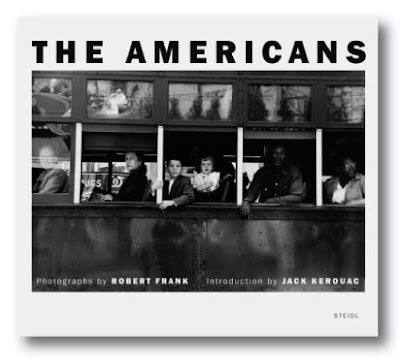


"“The Robert Frank Project” is an ambitious long term publishing programme which encompasses Robert Frank’s complete oeuvre – reprints of his classic books, reprints of some less well known small books, the publication of previously unseen projects, newly conceived bookworks, and his Complete Film Works in specially designed collector’s DVD sets. This ensures the legacy of this original and seminal artist and that Robert Frank’s work will be available and accessible for many years to come in a scheme and to a standard that the artist himself has overseen."


It has some great stuff in it such as "A Short History of the Publishing of The Americans", "Robert Frank in Göttingen " (for the design and printing of the new edition at Steidl) by Joel Sternfeld, and a listing of all the books/films published so far and those still to be published.
"Robert Frank and I must have made an interesting sight that warm July afternoon on Düstere Strasse. We resemble each other but he is older than I so no matter what we were up to we could have made sense as father/son.

And in one important sense we were: when I was becoming a photographer in the late 1960s, his book, “The Americans”was already a landmark–that’s much too weak a word but what other word for a body of work that changed the course of the river of Photography in a way that it could never take the old course again.

I would look at it before I went to sleep and in the morning I would reach for it like a smoker reaches for a cigarette. I needed to see it again. The country was so bleak in those sooty pages, each one an artifact ripped from the landscape and brought straight to the bindery. Frank had found a way to give form to the formless lives that went unmilled in America.


Two years before I encountered his book I had taken my first cross-country trip–three of us in an immense gold driveaway car that needed to be delivered to its owner in Los Angeles. We sailed from the East Coast to the West in less than three days–one of us sleeping across the back seat, one up front trying to stay awake with the driver.

It was December. We angled into New Mexico as the sun was going down and pulled into an A. and W. Root Beerstand. The dirt parking lot seemlessly joined the desert and the desert night. A cold wind came up as the sky turned black–the same cold wind every traveller without a room feels as the sun goes down.


A wrapper from someone’s fries blew into the desert in a moment of Americanized infinity. Frank’s book reminded me of that moment. And now here he was on Düstere Strasse in Göttingen and here I was beside him. Inside at Steidl “The Americans”was being printed–the reproductions were to be as close a match as possible to the Delpire edition that had set Photography on its fat ear when it first come out in 1958...(Joel Sternfeld)

"
Finally, of course, the is the Americans itself and it's 50th Ann9iversary in 2009, with an exhibition going from The National Gallery of Art, to SFMOMA to The Metropolitan Museum of Art. 2008/2009 is going to be the year of Robert Frank and The Americans...


Thursday, March 20, 2008

Gabriele Basilico: Silicon Valley, 07

(Gabriele Basilico, San Francisco, 2007, 2007; Digital pigment print; 23 5/8 in. x 31 1/2 in. (60 cm x 80 cm); Collection of the Artist; © Gabriele Basilico )

I mentioned this book way back at the beginning of the year in my selection of upcoming books for 2008 - Gabriele Basilico: Silicon Valley, 07 .


As I understand it, Basilico was commissioned by SFMOMA as part of a project exploring the current state of Silicon Valley and the effects of the technology boom on the region.

I think people tend to fall into one of two groups - either they like Basilico's work or they don't and can't really be bothered with it. Obviously I'm in the former group...


(Gabriele Basilico, San Francisco, 2007, 2007; Digital pigment print; 39 3/8 in. x 51 3/16 in. (100 cm x 130 cm); Collection of the Artist; © Gabriele Basilico)

This is a very nice, large size (larger than many of his recent books) and well printed book. But what's especially intriguing is how much of the work is in colour - I haven't counted, but probably close to a third of the pictures.


(Gabriele Basilico, San Francisco, 2007, 2007; Digital pigment print; 39 3/8 in. x 51 3/16 in. (100 cm x 130 cm); Collection of the Artist; © Gabriele Basilico)

Some of Basilico's colour wok has shown itself before, such as in the Beirut book for example, but not a lot compared to his B&W work. And it is black and white that he is predominantly known for.

A couple of things about that - first, the colour work is extremely well and beautifully done. But secondly, it runs seamlessly with the B&W work. Basilico makes it look easy here, but my opinion is that it's quite difficult in the first place to make successful colour and black & white photographs of the same subjects at the same time (or thereabouts - which is what Basilico seems to have been doing). Not only that, but I've rarely seen a monograph type photo book of one project or subject that works well with mixed colour and black and white - I can think of very few. Yet my experience here was that in looking through Silicon Valley, 07, I hardly even noticed when the work changed from one to the other and back again. But it influences the whole book overall.

I'd certainly love to see the exhibition of this work which is on at SFMOMA (on until June 15th) - going to have to keep an eye out for cheap flights...


(Gabriele Basilico, San Francisco, 2007, 2007; Digital pigment print; 23 5/8 in. x 31 1/2 in. (60 cm x 80 cm); Collection of the Artist; © Gabriele Basilico)

One the content of the book, Basilico does have a certain style - although he rings the changes within that. And while a number of the pictures clearly say "US of A" or "California", I was surprised to see how, through Basilico's eye, so many parts of the Western US look curiously like the parts of suburban extra-urban and post-industrial Italy he has explored for so long. The homogenization of such regions is a global phenomenon which more often than not submerges local uniqueness in favour of the generic.


(Gabriele Basilico, Redwood City, 2007, 2007; Digital pigment print; 23 5/8 in. x 31 1/2 in. (60 cm x 80 cm); Collection of the Artist; © Gabriele Basilico)

Basilico's work has a deceptive simplicity to it. There have been quite a number of books by Basilico that have come out in the last couple of years - a glut even... (and more yet slated to follow). This book has quickly become one of my favourites.


(Gabriele Basilico, San Jose, 2007, 2007; Digital pigment print; 23 5/8 in. x 31 1/2 in. (60 cm x 80 cm); Collection of the Artist; © Gabriele Basilico)

(Many thanks to SFMOMA for the images here)


Wednesday, March 19, 2008

The Other German School

(Dirk Reinartz)

Or one of them at least.

I mentioned Michael Schmidt the other day and our Icelandic correspondent pointed out a few of Schmidt's contemporaries and colleagues (a couple of whom I had come across before).

Interestingly all three of them were involved in the Folkwang Hochschule in Essen (and others, such as Paul Graham, seemed to become part of this loose informal grouping). Photographers and artists working together, exploring, learning usually seem to influence one another in certain ways. There is a common thread - thin and frequently tangled - which often binds them together. They may well explore different directions in their work, but there is frequently something that can be traced back to a common root.

It's been my experience that while photographers are often quite broad church in experiencing work that is quite different from their own, like most of us they also have a tendency to gather together with those of a like mind - often focusing their collective energy on solving the same problems from several different angles.


(Gosbert Adler)

Gosbert Adler teaches in Hannover, and lives and works in Berlin. One theme in his work is cars and traffic and the faces (orfacelessness) of those travelling cocooned in them. He was recently commissioned to photograph the Italian town of Reggio Emilia.
"His work for Reggio Emilia, entitled Streets, cars and drivers, is divided into four parts: the streets, the cars, the drivers and the river.

These concepts form part of a project that the author started about two years ago, related to cars and to "living with cars".


(Gosbert Adler)

Gosbert Adler has this to say about this project:

"I came to Reggio Emilia with one idea; I was interested in cars, and I wanted to continue working on cars, as I also dealt with this theme last year. I was interested in the idea of working in a country that I was familiar with for completely different reasons, for example, somewhere to take a holiday; I think it is interesting to see a place with different eyes. I visited places like the town's suburbs and the province's boundaries for the European Photography Week, for example, like the route between the towns of Reggio Emilia and Parma or between Reggio Emilia and Modena. I generally take photographs of places where there are no people, and then I create another ad hoc stage for them, for example, in cars. The street is the boundary between private life and public life, the limiting line, if you like. For me, the question of the theme, in this case, the Limit and the Boundary, is defined in the following way: can it be useful for me as a starting point? is it important for me? And then I start work, without thinking about the theme any longer. Everything must take shape independently. I dealt with the private life of persons in my previous work based on the objects they preserve or the objects that surround them; you could say that my work has always something to do with boundaries and with limits. I find the situation where the car is stationary at a red light interesting; this is a time when the persons are present for themselves, therefore they are concentrated. Sometimes they let their glance astray, but it is as if they were, to use a German expression, "in a shop window", but fundamentally they feel present for themselves. We are all familiar with the situation where we are stopped at traffic lights and we have the feeling of sitting at home, and this is the situation that I am interested in taking photographs of. These are not real portraits because sometimes the photograph is taken of people from the rear or from the side. Therefore, I am interested in the correlation between the private and the public sphere; to be in the car can be an important moment for my project"."


(Gosbert Adler)

Dirk Reinartz taught in Kiel and sadly died much too young in 2004. Although much of his long-term work is usually tied in with Richard Serra's sculptures, he has worked in many other areas too - his "Benchmarking" series, as well as Bismark in America have an undercurrent of dry humour to them. But his project totenstill is especially powerful:


(Dirk Reinartz)

In 1987 the photographer Dirk Reinartz began documenting the journey of sorrow: Dachau, Auschwitz, Ravensbruck, Treblinka....The list is a long one. Seven years later he had compiled a series of 200 black-and-white photographs of the remains of the 24 death camps. The similarities between the remains at the different places - the presence everywhere of railway tracks, barbed wire, concrete, windowless walls, and the absence of details - testifie to an inhuman mechanisation and the total institutionalisation of power and cruelty.

(Dirk Reinartz)

Dirk Reinartz began his photographic journey as a private project to convey to his son, born long after the war, the horrific reality of the past. Anyone who has seen these pictures of the deathly stillness of these places that were once concentration camps, the factories of death, can never repress their memory.

(Dirk Reinartz)

Lastly, Timm Rautert, who now lives and teaches in Leipzig.

(Timm Rautert)
"Rautert, who retired in 2005, started out as a photojournalist and conceptual programme artist (he liked to describe his work as an extended photography manual), then moved on to a rather melancholy documentation of the latter-day, increasingly invisible working world and of the way we exhibit works of art... Rautert's pupils extend the prevailing narrative element in their work to encompass the film-like sequences and epic structures of a photographic literature, as readily apparent in Falk Haberkorn's photography."

(Timm Rautert)

With all these three - and Schmidt - although their individual work has taken them in different directions, there is still something of a common thread that wends it's way through their approach to their work.

Monday, March 17, 2008

Manufactured Landscapes... not so good?


I must admit that I've resisted watching Manufactured Landscapes about Edward Burtynsky, even though both the local library and the local video store (are they still called that?) have it.

But reading Timothy Archibald's recent critique of it, I may finally have to take a look (although in my head I will probably be comparing it to two "documentary" films I watched recently the brilliant My Architect [actually, re-watched it as it was on TV] and the quirky, mildly annoying but illuminating William Eggleston in the Real World.)

Here are a few of Archibald's somewhat restrained comments:

"Friday night I rented this documentary and watched it at home. My wife loved it, felt it had an important message about man's impact on the environment, and was really taken by EB's photographs. I felt differently: if I ever wanted to make photography seem boring to a bunch of students, to discourage them from getting into the field, this is the film I would show them.


The DVD seemed like a promotional handout that would be given to collectors interested in purchasing E.B.'s work. In the same way that people who purchase a Toyota Prius now feel like they've done some good, this film seemed to try to encourage buyers that E.B. really cares, that this work is important, that the planet will be saved. Then...as we explore the DVD extras, Al Gore is chiming in on one of the segments. WTF??? His inclusion on this film was so expected, so calculated, any thinking viewer saw it coming....

...So...why do I hate on this film? Is it because E.B. is so popular and successful? Maybe. But I think there is this feeling of liberation that comes when you see a person so deeply invested in their art, instilling their photographs with all the weirdness they have in themselves, and just being honest about it all and mixing it all up together. E.B. didn't have that...he seemed so detached, like he could have been doing any number of things successfully for a living but just happened to choose photography. Well...what's the problem with that?

I think it just comes down to a revelation about my personal taste. I like looking at weird photographs done by unusual people. Is that O.K. to admit?"

And I'll finish, with an image not by Burtynsky, of one of Louis Khan's incredible buildings (see My Architect above)


(Photo by "The Nose" via Wikipedia)

Sunday, March 16, 2008

31 Under 31 - Young Women in Art Photography


(Tealia Ellis Ritter My dream is to be an artist, Milan, Illinois, 2007 — from the series The Live Creature)

At the beginning of the year, the
Humble Arts Foundation put out a call for submissions to an exhibition - 31 Under 31 - Young Women in Art Photography - aimed in part at emerging photographers. The exhibition opened at the beginning of the month (and by all accounts the opening was packed) and is showing at the Gallery at 3rd Ward in Brooklyn.


(Ahndraya Parlato Untitled, 2007 — from the series Inscape)

It's a little hard to find the photographs online right now (I hope Humble is going to put more of it up eventually?), but thanks to Flak Photo it is possible to view a few (halfway down the page). I'm also familiar with the work of several of the photographers.


(Alejandra Laviada - Stacking, Mexico City, Mexico — from the series Juarez #56 )

I must say, having recently looked at Photo District News' 30 Under 30 selection, that with a couple of exceptions the 31 women blow that selection out of the water. Now I realise that the criteria were a little different, but it struck me that the PDN choices were rather disappointing. They went with what was safe - and derivative - young photographers following in the tracks of the trends of the last 3 or 4 years. You could pretty much pick out your Amy Stein clone, or your Todd Deutsch clone or your Anders Peterson clone or you Philip-Lorca diCorcia clone etc.


(Jessica Bruah - Untitled #13 — from the series Stories)

Whereas from what I've seen, the Humble managed to find an exciting group of young photographers who seem much more focussed on finding their own way. I don't know, maybe that extra year helped... (never trust a photographer under 30 :-) ) - or maybe it was that they chose all women. But I also think it has a lot to do with the Humble Arts Foundation's own vision.


(Jaimie Warren - Untitled (Naoko/Squid Teeth), 2007)

"Lumi Tan, Director of Zach Feuer Gallery in NYC, and Jon Feinstein, Curatorial Director of Humble Arts Foundation co-curated the exhibition. "While it is impossible to capture the full breadth of international talent by female photographers in one exhibition," say Tan and Feinstein, "we feel that the diversity of subjects and intent are a clear representation of the wide range of skill and creativity that is flourishing today. By allowing the works to be culled from an open call, we hope to give exposure to unknown photographers while simultaneously showcasing more familiar names in contemporary photography.""

(Mary Mattingly -The Hunt, New York, New York)

The exhibition includes photographs by Amy Elkins, Ashley Lefrak, Dru Donovan, Elaine Stocki, Helen Maurene Cooper, Ka-Man Tse, Mary Mattingly, Ahndraya Parlato, Alejandra Laviada, Alana Celii, Alex Van Clief, Allison Grant, Catharine Maloney, Dina Kantor, Hannah Whittaker, Jessica Bruah, Jessica Roberts, Jaimie Warren, Kate and Camilla, Kelly Kleinschrodt, Marta Labad, Manya Fox, Molly Landreth, Nadine Rovner, Rachael Dunville, Reka Reisinger, Sara Padgett, Sarah Small, Sarah Sudhoff, Talia Chetrit and Tealia Ellis Ritter.

I think now it's time for the Humble to do "45 and over - Mid-Career Old Fart Photographers"


(Ashley Lefrak - Headless Horse, 2007 — from the series American Documents)

Photoshop Disasters

Here's a fun blog to look at over the weekend - Photoshop Disasters - mainly about magazine covers and newspapers...

A couple of my favourites:

Out Magazine: Hey Mr DJ Put A Record On I'm Microcephalic


It looks great, yeah great. You know, one little thing. No big deal. But if you could make the top of her head smaller? Just the top part? So it isn't hiding the banner. Yeah, no, I know, but you know what, no one cares about the top of her head. Just make it smaller. Yes, I know. Just make it smaller. Just do it. I'm just going to go ahead and make that an order. If you could do that, that would be great.

Oh, and if you could make her shoulder disappear, that would also be great.


and

FHM: Yakuza Babes


At 4am somewhere a designer wakes up and utters "Oh God I forgot to put her finger back in."

Make sure to take a quick look back through the archives.

(Oh - and I'm pretty sure Anne Coulter's hand really does look like an alien's - I don't think that's a phtoshop mistake...)

Thursday, March 13, 2008

Michael Schmidt

My second post on this blog was a fairly brief one about Berlin photographer Michael Schmidt. It's quite hard to find a lot of information about Schmidt online and the same goes for his pictures - and yet his influence on many contemporary photographers is significant - among his pupils are Andreas Gursky and Ulrich Gorlich - and his working colleagues include Lewis Baltz, William Eggleston, Paul Graham and Robert Adams. Basically, you need to get the books or go to the shows.


Then other day I saw a refence to a rare N. American exhibition (he has actually had two solo shows at MoMA in 1988 and 1996) of his work at Mitchell-Innes & Nash in NY - which also has a small selection of pictures online.


"Schmidt arrived at a strategy of disseminating his work early on. He photographs large quantities of images without a specific project in mind. These images are then organized into groups with socially evocative titles, such as Ausländische Mitbürger (Foreign Co-citizens, 1973) or Berlin, Stadtbilder (Berlin, Images of the City, 1976-80). He exhibits the work in clusters or groupings intended to draw relationships among the images, often in a public context, and then, circumstances permitting, publishes a book of the images. Unlike many artist monographs, Schmidt’s books are not intended to catalog discrete images but rather to interconnect images dependant on those associations, mirroring his process of hanging photographs on the wall. The books tend to be light on text—often having none other than the title—and are truly more artist book than monograph, despite mass production by major publishers...


...Schmidt continued to explore a landscape and a city fraught with history in his pivotal work Ein-heit (U-ni-ty, 1991–94), shown at the Museum of Modern Art, New York, in 1996 and published in the same year. The importance of fragmentation as an interpretive trope is reinforced by Schmidt’s dividing with hyphens a word meaning wholeness, diametric forces embodied in the very title of the project. Conventional aesthetics of black and white photography were abandoned in favor of intentionally inconsistent prints, often with compressed, almost monochromatic tonal ranges, large grain, and poor detail, all of which served to reinforce his subjects. The book presents a startling record of Schmidt’s fascinations with the weight of history upon the German citizen, the cultural lineage behind his project, and the interrelatedness of past and present, and the impossibility of truly knowing, especially through photography. A project of epic scope, Schmidt included photographs that he made of portraits and landscapes in Berlin, photographs of objects of significance to the German populace, and re-photographed images resonant in collective German memory. By combining portraiture of ordinary citizens with landscapes changed through history and historical material, Schmidt points to the effects of the latter two on the subjects in the portraits. Examples of re-photographed materials include stills from Leni Reifenstahl’s 1934 Nazi propaganda film Triumph of the Will, photographs of soldiers of the German Democratic Republic passing a review, and a tablet inscribed with the third stanza of the German national anthem, the lyrics of which were used under the Weimar Republic and the Federal Republic. Images are doubled on facing pages, cropped tightly to fragment the scene, printed backwards, and otherwise freely manipulated.


Dense with precise historical references but also elusively vague at points, and lacking a declarative personal style, Schmidt’s work has not achieved the international market success of many of his better-known German contemporaries. Nonetheless, Schmidt continues to live and work in Berlin, weaving his own layers into the variegated strata of German culture and history. His legacy is already enormous. (from the 20th Century Encyclopedia of Photography)"


Probably the two easiest books of his to get hold of are Michael Schmidt: Berlin Nach 1945 and Irgendwo. His best, and possibly most important, book is Waffenruhe - but it's almost impossible to find and even more impossible to find at an affordable price ($1250.00 at Vincent Borrelli)


""Irgendwo" presents rather bleak views of province-life in the reunited Germany with suburban houses and village pubs, deserted low-cost supermarkets and historical buildings, as well as distanced motorways cutting through the landscape. Typically for his Modus Operandi Schmidt conflates architectural and landscape photographs with portraits and shots of seemingly unimportant details. It is only through the arrangement in groups - the interplay and dialogue between the images - that the individual images acquire their distinct meaning and the issue of a relation between spatial environment and individual biography comes into view. The photographs, however, do not depict particular places. In his work Schmidt seems to be more interested in tracing the loss of a subjective connection to "home as a place with identity":


"Home says nothing to me. In any case, home is what you carry with you, inside you. You remember places because you spent the most wonderful or the most horrible time there during your childhood. But these places have become more arbitrary, less specific. ... There is no such thing as an objective category that one might call 'home' any more. Such things take place subjectively nowadays."" (Michael Schmidt)


There's information on a previous exhibition of Irgendwo here

Personally I find looking at Schmidt's photogrpahy to be an intense and deep experience - in many ways it is a counterbalance to (or antidote to?) much contemporary photogrpahy, especially of the Gursky, Struth or Soth style. Even some of his "straightest" images have an air of enigma about them and their are layers to unravel - especially in a series. It provokes thought and imagination, having the depth of a good poem - and it takes as much work as reading a good poem to draw out its many meanings.

Wednesday, March 12, 2008

Greg Crewdson


I got the new issue of Aperture the other day and it's one the couple of issues a years that's actually worth getting - with several good articles in it.


But a major feature is about the work of Gregory Crewdson. Aperture has also gone to town on their website with a whole interactive setup with images and interviews with him and his crew around one of his more recent projects: Beneath The Roses. (Along with the obligatory book - interestingly, not by Aperture)

I also just finished watching the last of the BBC series - The Genius of Photography (very good overall BTW) - in which Crewdson is featured - working on the picture below, among others.


I don't intend to go into examining Crewdson's work in depth here - that's far to big a project involving comparisons with others such as Geoff Wall, Joel Sternfeld, cinema (and numerous directors), fashion photography, the history of painting and so on...


Needless to say I do quite enjoy Crewdson's work. It doesn't quite bowl me over in the same way as the work of certain other photographers, but it holds my attention and causes me to think. I enjoy what he does and how how it looks.

What I did want to mention was how some people seem to react to Crewdson's work - sometimes quite vociferously. It's not the actual photographs they seem to dislike, or even that they are constructs, sets, staged, but rather the way he makes them. Some folk seem positively offended because he isn't just one man and his dog and a big camera on a tripod taking the pictures, but that he has a whole crew - not just actors in his scenes, but lighting crews, a director of photography and a camera operator. Somehow this seems to cause an outcry in certain areas, along with an awful lot of angst, with comments along the lines of - "he doesn't even take his own pictures", "he's not a photographer, damn it (bah humbug...)"; "why does he need someone else to do the work for him" etc etc

"On Main Street, Pittsfield Massachusetts lights are being rigged, props are being positioned and actors are taking their places. It looks like a movie, sounds like a movie and smells like a movie, but it isn't. All of this activity is to make a single photograph, by Gregory Crewdson.


"I work with a production crew that all come out of film. We work with cinematic lighting but we are only after creating one single perfect moment." (Gregory Crewdson, photographer)

Over an 11 day shoot in a variety of locations Crewdson's team will make a series of multiple exposures which will be digitally combined to make six final images. He'll produce an edition of six prints of each image priced at approximately $60,000. There's already a list of prospective buyers.

With his striking tableaux which combine Hollywood's production values with suburbia's bad dreams Crewdson has become hot property, confident that he has an audience who will appreciate, and if they can afford it, buy his work. For Crewdson the business and benefits of being a photographer feel very different from the experience of earlier generations. (From The Genius of Photography, BBC)

And I guess what surprises me is that - well, it surprises me. I find it a little hard to comprehend how someone can get worked up about how Crewdson produces his pictures rather than the pictures themselves. Love them or hate them (or be indifferent) - but that he has someone click the shutter for him - so what?


One final bit of analysis of Crewdson and his work - it has obvious links with cinema, and in some ways with the early proto-cinematic photography of Muybridge - someone who didn't think twice about having a whole crew assist him in his project.


Monday, March 10, 2008

A couple of updates - Robert Capa and Karl Hoecker


First, the Digital Journalist has a brief update on the work being done on the newly recovered cache of Robert Capa's negatives:

"...Cynthia Young told me the negatives were in remarkably good shape. This was perhaps because of Mexico City's climate. The three suitcases were in a stable environment in an attic where it was dry and the "boxes" were not moved around. This is important because not only was the climate a factor, but the fact that the rolls of film were intact and in good shape will make the job of unraveling each roll that much easier. No chemical work is necessary, remarkable in itself considering the film is 70-year-old nitrate stock. According to conservation experts, the rolls are "like they were made yesterday. They are not brittle at all" – a good sign for the future when the photos will be put on public view. Once there is a digital image of each frame, the work on the roll is complete, and it is placed in cold storage to further protect the discovery. Importantly, because Capa and Taro kept extensive notes about the pictures they took, each suitcase, as we can see from these photos, had extensive notes about each roll of his and her film. Capa and Taro were good record keepers. Contact sheets were important to the way they worked. The extensive notebooks and tear sheets they kept are in the hands of the ICP, and the newly discovered rolls of film correspond to these notes and contact sheets. In some ways, Cynthia Young of ICP says, they do not expect many surprises from the Capa and Taro film. But even at this early date, the curators are able to see how in some cases a negative changed as it passed through the darkroom to become a print. In the future this will provide exciting material for scholars, journalists and the public.


(Robert Capa)

However, there is a strong belief that there will be surprises in the Chim photos because there is no complete record of what he shot. Curators are also making digital copies of each Chim photo. These represent about one-fifth of all the rediscovered negatives, and it is here where they expect to find something new...."
And just as I finished writing this post, I came across another article - The Mexican Suitcase by Trisha Ziff on Zone Zero - the fascinating story, very well done, of tracking Capa's suitcase down in Mexico.


Next, on the album of photographs taken by Karl Hoecker, Adjutant to the Commandant of Auschwitz; Jim Hoerricks of the Forensic Photoshop blog has pointed out that next week's New Yorker has a story on them. My guess is that Jim did some work for the story on showing that Hoecker was indeed on the ramp at the railhead in Auschwitz - based on the evidence of the only other album of photographs from Auschwitz, the "Lili Jacob" album - and contrary to the evidence that was given at his trial, at which he received a lenient sentence as a result.

(Unfortunately, there are only some of the pictures online at the New Yorker - you'll need to by the magazine if you want to read the whole story...).


Sunday, March 09, 2008

Luis Belmonte Díaz


A while back I was looking for photographers who were doing urban winter photography and I came across the work of Spanish photographer Luis Belmonte Díaz.


It was
Zima (Winter), his work from Poland (I think he is based in Warsaw?) that caught my eye - I really like the way he has managed to capture this kind of long winter around the city.


But there are several other sets of work on his site (love the minimal front page...), such as
Gdansk which are also well worth looking at.


He also has a
low-key blog - sort of "Field Notes" of his day to day photography.


Saturday, March 08, 2008

Deutsche Börse Photography Prize - Esko Männikkö


Well, Esko Männikkö was the winner of the Deutsche Börse Photography Prize last week.


There's an interesting little piece in the Guardian on
Männikkö and the prize:

Who said never work with animals or children? Last night the most sought-after prize in fine art photography was handed out, and the £30,000 cheque went to a man whose winning exhibition included close-up portraits of horses...


First, excuse the bad pun but I think the judges backed a good runner. The winner, Finnish Esko Männikkö, has called himself a "photographer of fish, dogs, and old men". The horsey shots in his winning exhibition - which are a million miles from pet portraiture or equine machismo - are a refreshing break from the usual array of human portraiture, reportage and landscape subjects. Instead, his guiding principle is a simple sense of capturing unusual natural beauty - whether animal, vegetable, mineral or human - wherever it arises...


What's so fascinating is the way Männikkö immerses himself with his subjects - human or otherwise - in remote parts of Finland. I was lucky enough to go there recently, and I too discovered a nationality still in thrall to nature, folk customs, and in some cases a tendency towards melancholy, yet often this is concealed beneath Nordic propriety. What Männikkö's pictures do is completely rub off that modern, social patina and uncover the deeper character that lurks beneath. His portraits of people are just as magnificent as those of wild, untamed beasts...

Thursday, March 06, 2008

The Ecology of the Novel - traces etc

(Venezia 1939/tim atherton)

A couple of days ago I came across an interesting essay about my own work - traces, Peripheral Vision and Immersive Landscapes.

"...Atherton’s collection of Traces seems pretty much inspired by Calvino’s remarks from the Invisible City (Le città Invisibili, Torino, Einaudi, 1972), that may even count as a very interesting meditation on hybrid ecologies based on the merge of literary references and sensory experience of landscapes. Namely, the bare concept of Le città invisibili entails open reference to cities that are there even tho they are not perceivable by sight. Actually, Atherton’s Traces exert potential of landscapes referring to previous or potential actions. The camera can help guessing or foreshadowing past or future events on the basis of clues, leftovers, affordances ready to be triggered by somebody who’s actually out of the picture..."more

Some months ago, Anatole Pierre Fuksas contacted me to find a bit more about my work and said it fitted into a project he was working on - a book called The Ecology of the Novel.

Fuksas teaches in the Department of Linguistics & Comparative Literature at the Università degli Studi di Cassino in Italy and one of his areas of research focuses on the relationship between literature and reality - the ecology of the novel:

"...the novel does not imitate a given reality through language, as claimed by approaches based on aristotelian mimesis. Likewise, it does not establish a more or less consistent fictional world intersecting an actual one more or less consistently, as theories based on modern epistemology offer. Indeed, the novel is not the mimetic reflex or the dialectic alter ego of a given reality, since ‘reality’ and the novel are different outcomes of the same process. They both answer questions like when, why, what ‘to do’, implicitly providing given definitions of ‘doing’. That is, they both rely on an integrated network featuring perception and action, reason and emotion in order to plan meaningful actions. Since the novel and that special ‘thing’ humans call ‘reality’ are built in the very same way, to keep regarding novels as imitations or virtual reflects of a given reality definitely sounds sort of naïf."

He is writing a blog as a day-by-day work journal documenting the development of his research plan on "The Ecology of the Novel". As part of that he has also investigated how certain artworks do a similar thing visually and what he calls an ecologically artistic approach to landscape for part of which he examined my own work.


(Venezia/Trieste 1939/tim atherton)

Wednesday, March 05, 2008

Update #2: Friedlander's Olmsted


The other day I wrote about the current exhibition and book of Olmsted's parks and landscapes by Lee Friedlander.

Well the book - Lee Friedlander: Photographs Frederick Law Olmsted Landscapes - arrived yesterday. I only had time for a fairly brief browse, but it's a gorgeous book. The pictures live up to expectations and the printing and paper is just superb - the images are very "photographic" with a wonderful depth. And the overall design and feel of the book results in a very satisfying experience for the reader (viewer?) - at least for this one anyway. Everything down to the colour and feel of the linen cover and the sort of tipped-in print on the front comes together so well.

Update #1: Odd Photographers


Just a quick update on yesterday's post on the Metropolitan Police's hunt for odd photographers.

Here's the script text from their radio spot"

Female Voice over:
How d’you tell the difference between someone just video-ing crowded place and someone who’s checking it out for a terrorist attack?

How can you tell if someone’s buying unusual quantities of stuff for a good reason or if they’re planning to make a bomb?


What’s the difference between someone just hanging around and someone behaving suspiciously?

How can you tell if they’re a normal everyday person, or a terrorist?


Male voice over:
The answer is, you don’t have to.

If you call the confidential Anti-Terrorist Hotline on 0800 789 321, the specialist officers you speak to will analyse the information. They’ll decide if and how to follow it up.

You don’t have to be sure.

If you suspect it, report it.


Call the Anti-Terrorist Hotline on 0800 789 321 in confidence.


(you can listen to it here)

This is just bad in so many way's I don't even know where to start (leaving aside the implied sexism of the actual sound version)

Monday, March 03, 2008

Has the Met been taking lessons from the Stasi?


I wonder, has the
Metropolitan Police (London U.K.) been taking lessons about how to run an informer society from the old East German Stasi (after all, those 90,000 ex-Stasi agents must have something to offer to someone)? Below is a jpeg of the Met's (along with the City of London Police and the British Transport Police) latest "Counter Terrorism" campaign (they are also targeting people being suspicious in their home or using cell-phones...hmm).


You can link to the
pdf here for a better look (as well as click on the images for a slightly bigger view):
THOUSANDS OF PEOPLE TAKE PHOTOGRAPHS EVERY DAY. WHAT IF ONE OF THEM SEEMS ODD

Terrorists use surveillance to help plan attacks, taking photos and making notes about security measures like the location of CCTV cameras. If you see someone doing that we need to know. Let experienced Officers decide what action to take.
Funnily enough, I just came across a copy of Orwell's Road to Wigan Pier today in the library at work so he was on my mind as I looked at this. I wonder what old George would have thought...?


Peter Jones on the Streetphoto list brought the campaign to my attention and John Brownlow came up with a couple of suggestions about what their next few posters may say. I added one of my own as well. Funnily (and sadly) enough, they don't seem that far-fetched.
In all honesty (and I write as someone who has dealt with violent terrorists first hand - no armchair critic here) I have to ask - what on earth were they thinking when they came up with this?


All I can say is that 90% of the photographers that I know - obscure or well known - are a little "odd"...


(Oh, and if any Met Public Affairs wonks are reading this, the use of the poster comes under both satire and commentary fair use under all relevant Copyright legislation...)

Sunday, March 02, 2008

"Muybridge's Horse" - Rob Winger


A spellbinding work of poetry,
Muybridge's Horse is something of an epic poem, taking in it's scope the whole of Eadweard Muybridge's life and work.

It is a first publication for poet Rob Winger and although it falters in a few places, it's good (and at times excellent) sections more than make up for it.


In form, it certainly owes a lot to Michael Ondaatje's majestic
The Collected Work's of Billy The Kid, but in this case, Winger certainly makes the form his own. He draws on all sorts of sources about Muybridge's work and life, as well as from further afield (there is a good little quote from Diane Arbus that every photogrpaher would do well to remember: "The more specific you are, the more general it will be")


the split second in walking when both of your feet are airborne
the distance between a target and the knowledge of a gunshot
water in your throat
the space of decline when a masseuse’s finger slips from a knotted muscle
the time between balance and impact with the earth
my fingers submerged in water, in a dive
the moment, in a train lavatory, when a sideways sway has thrown a spray of urine
away from the bowl’s mouth
any sporting ball suspended in the air
the heat of mouths before lips contact
the time between an engine and the sound of it
the stretching of a knuckle before it cracks
a drill changing its tonality as it contacts a sheet of maple
whole snowflakes as they meet your tongue
a minute hand jumping to its next hour before the clock can chime
the stretched pressure of a guitar string before sound
the darkness that happens before any object collides with your face
the second of ease when the piano you are pushing has built up enough force to glide
any form of jumping
waves

a bird in flight

------------------------


reading the Plaza of Antigua

All across the frame, people have refused capture.Their bodies, brief streaks of light across the market’s noise.Bodies arriving at the paper’s surface from the hills as though they’d dropped from the background - clothing filling the frame with contrast.

Eadweard uses their blurs.Some have stood, perhaps, for hours, under a certain shadow, and (seeing Eadweard place the wet plate into the camera’s box) have jumped from permanence.Their bodies are ghosts, transparent, building’s bones seeping through grey skeletons, half-exposed on glass.

This curve of colour is a woman, arguing over the price of beans.This round whirlwind of white light, a boy spinning in place.This silver banner, a man who’s just exited the frame to walk ten miles back to his village, up the side of the volcano, toward sky.Two specific legs support a burst of light, where a figure has bent to the ground in a perfect semicircle, painting the foreground with waves.The dance of a young woman in a white dress paints a halo behind a fixed, staring farmer.Angelus novus.

Eadweard’s finger must’ve traced the gradual background curve of Volcano Agua against the air before framing it in the dry photograph’s top half.He must have positioned the Palace of the Captains General intentionally, so its highest corner just grazes the slope in the background, a meeting of territories.Volcanic throat against stone’s collarbone.


Like Eadweard, I’m attempting to fix blurs, to translate motion into language.Like Eadweard, I want permanence, want things named.I lean into the paper’s grain, watching, smell its dust lifting from the book, sunlight falling through the window into the centennial clouds of moving bodies there.This image, traveling the entire North American mainland, over a hundred years of distance, to find me here, in the particular light of a Canadian afternoon.

Frame around the image, marking possibilities. Circles of light against the nails.

In the picture, round baskets perforate the cloth geometry, balanced on heads, giant nails digging into dirt.Every stall is covered by the tilt of a square umbrella, each reflecting the sun in a white shine.The squares float like prints drifting in the development bath, edges curled from the acids’ work.Your eye can hop from one to another without dipping into the river of bodies. Or, you can circle, move from umbrella to umbrella, around the square. Slip, if you like, from the surface into liquid and lose your boundaries.

(The most important time is happening between categories.)


P.S. I like the fact that if you flick quickly through the pages you get one of Muybridge's horses galloping along in the bottom corner - a nice little bit of whimsy in the book design.

Saturday, March 01, 2008

Admin Note - emails, replies etc etc...

(the photographer's studio - Josef Sudek)


Just a quick note, I've received quite a few emails recently related to this blog. Some just saying "hi" or thanks for the blog, others with questions, others asking me to look at the senders work and so on.

My apologies if I haven't replied. As well as being a bit under the weather lately, I've also been getting going on a new "proper" day-job as a curator/(photo) archivist, so it's been a little bit crazy and disorganized at times.

I do hope to get around to all the messages though. So if I haven't replied, you aren't being ignored... :-)